
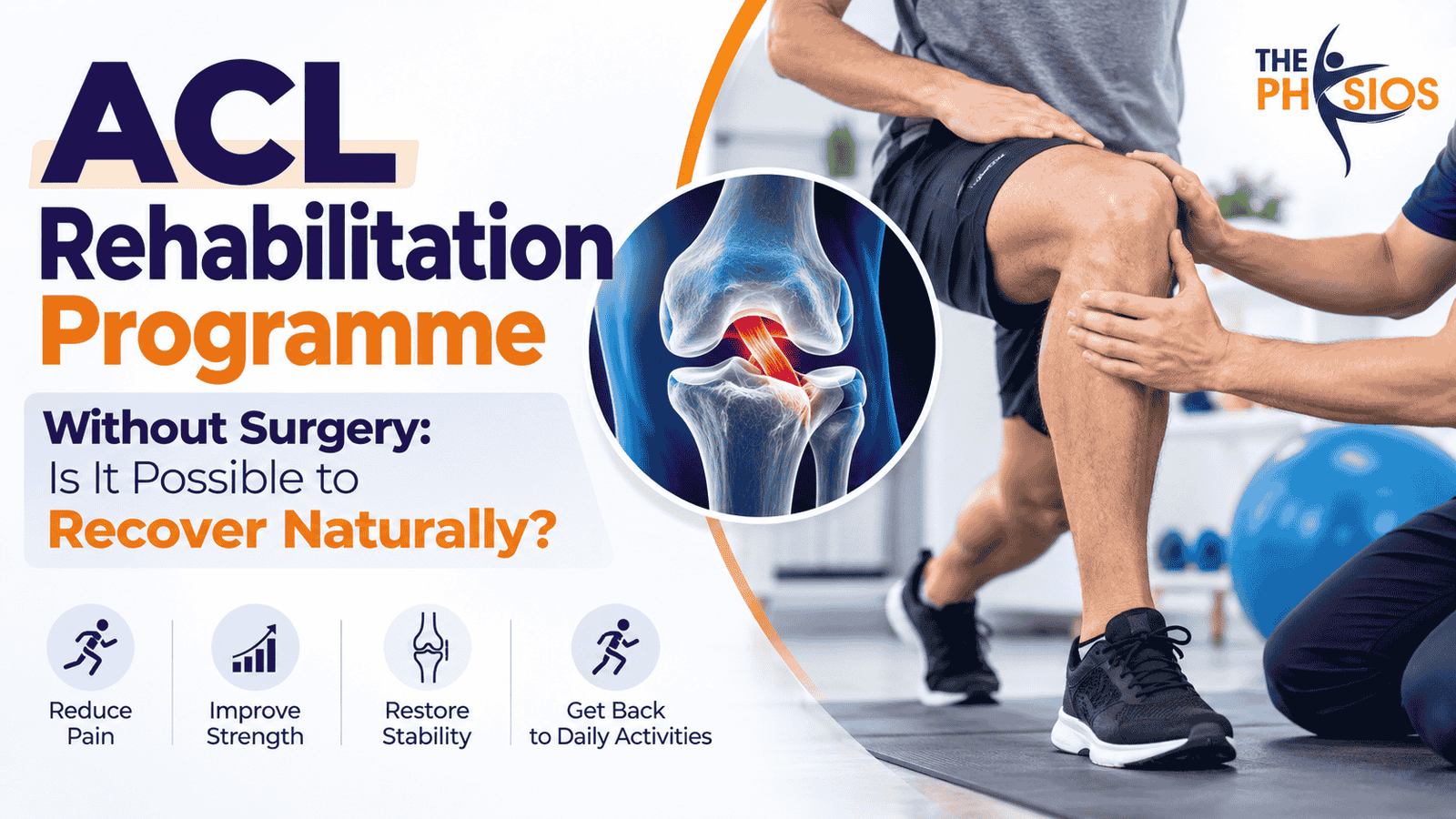
You twist your knee during a football match, hear a “pop”, and the joint swells up within an hour. A few days later, the doctor tells you it is an ACL tear. Almost everyone in that moment asks the same question: “Do I really need surgery?”
The honest answer is: not always. Many people recover well from an ACL injury without going under the knife. But it depends on the type of tear, your age, your activity level, and how seriously you follow your rehab. In this article, we explain how a non-surgical ACL Rehabilitation Programme works, who it is suitable for, and what you can realistically expect.
First, what is the ACL and why does it matter?
The ACL (anterior cruciate ligament) is a strong band of tissue inside your knee. It connects the thigh bone to the shin bone and stops the shin from sliding too far forward. It also keeps the knee steady when you turn, pivot, or land from a jump.
When the ACL tears, the knee can feel loose or “give way”, especially during quick movements. This is why athletes often worry about it more than someone who mostly walks and sits at a desk.
Can an ACL heal on its own?
This is where a lot of confusion starts. The ACL has a poor blood supply, so a complete tear usually does not join back the way a fractured bone does. However, that does not mean surgery is your only option.
Here is what research and clinical experience show:
- Partial tears often heal enough with structured rehab that the knee becomes stable again.
- Complete tears may not heal, but the muscles around the knee can be trained to do the ligament’s job. Many people return to daily life, gym work, cycling, and even recreational sports this way.
- A large study from Scandinavia (the KANON trial) followed young, active adults with ACL tears. Those who started with rehab alone had similar results to those who had early surgery, and about half of them never needed surgery at all.
So yes, natural recovery is possible for a good number of people. The key word is structured. Resting at home and waiting for the pain to go away is not rehab.
Who is a good candidate for non-surgical recovery?
Based on what we see at our clinic, you are more likely to do well without surgery if:
- Your tear is partial, or the knee is not badly unstable on testing
- You do not play sports that need sudden cutting, pivoting, or jumping
- There is no major injury to the meniscus or other ligaments
- You are willing to commit to 3 to 6 months of guided exercise
- You are older, or your daily activity is mostly walking, stairs, and light fitness
You may need surgery if:
- Your knee keeps giving way even during simple activities
- You are a competitive athlete in a pivot-heavy sport
- There is a locked knee or a large meniscus tear along with the ACL injury
- You have tried proper rehab for 3 months and the instability has not improved
A physiotherapist and an orthopaedic doctor should assess you together. Do not decide based on what worked for a friend. Every knee is different.
What a non-surgical ACL Rehabilitation Programme looks like
Good rehab moves in stages. You do not jump straight to squats and running. Here is the general path we follow at The Physios. Your therapist will adjust the timelines based on your progress.
Stage 1: Calm the knee down (Week 1 to 3)
The goals here are simple: reduce swelling, protect the joint, and get the knee moving again.
- Ice, compression, and elevation in the first few days
- Gentle range-of-motion exercises like heel slides
- Quad activation (tightening the thigh muscle while the leg is straight)
- Walking with support if needed, then slowly without it
Most people are surprised by how much better the knee feels once the swelling drops.
Stage 2: Rebuild strength (Week 3 to 8)
Now the focus shifts to the muscles that support the knee: the quadriceps, hamstrings, glutes, and calves.
- Straight leg raises and bridges
- Wall sits and mini squats
- Stationary cycling
- Hamstring curls with bands
We also work on balance from this stage onward. Standing on one leg sounds easy, but after an ACL injury, it is one of the best ways to retrain the knee.
Stage 3: Balance, control, and confidence (Week 8 to 16)
This is where many home-based rehab attempts fall short. Strength alone is not enough. The knee needs to learn how to stay stable during movement.
- Single-leg balance on unstable surfaces
- Step-ups and lunges with good form
- Controlled hopping and landing
- Light jogging on flat ground if the knee allows
Your physiotherapist will keep testing your stability here. This is the stage where we decide if the non-surgical route is working.
Stage 4: Return to activity (Month 4 to 6 and beyond)
The last phase gets you back to whatever you love: running, hiking, gym training, or a weekend cricket match.
- Sport-specific drills
- Change-of-direction training
- Strength testing to compare the injured leg with the healthy one
- A gradual return-to-sport plan, not an all-at-once jump
If you are an athlete, our sports physiotherapy programme builds on this stage with more advanced training.
Common mistakes people make during natural recovery
We have seen these patterns again and again. Avoiding them can make a real difference.
Stopping too early. The pain goes away in a month, so people stop exercising. But the knee is still weak. Then it gives way on a stair and they are back to square one.
Skipping balance work. Strength exercises feel productive. Balance exercises feel boring. Both are needed.
Comparing with surgical timelines. Non-surgical rehab is not “faster” just because you skipped the operation. Give it the same respect.
Ignoring the other knee and hip. Weak hips often put extra stress on the knee. A good ACL Rehabilitation Programme looks at the whole leg, not just the injured joint.
Not getting re-checked. Follow-up assessments matter. If instability is not improving by month three, it is better to know early and discuss surgery than to keep pushing.
What if you already had ACL surgery?
Everything above applies to you too, with a few changes in the early weeks. Post-surgical rehab has its own protocol to protect the graft. If that is your situation, our ACL Rehabilitation Programme page explains how we plan recovery after surgery.
Also, if your knee pain is not from an ACL tear at all, it is worth reading about our knee pain rehabilitation programme. Many knee problems look similar in the first few days but need very different treatment.
Can you do ACL rehab at home?
Partly, yes. Most of the daily exercises are done at home. But the assessment, progression decisions, and hands-on treatment need a trained physiotherapist. For people who cannot travel easily, we offer physiotherapy at home across Noida and Delhi, where a therapist visits and guides you through each stage.
A realistic timeline
To set expectations:
| Stage | Approximate time | What you can do |
|---|---|---|
| Swelling control | 1 to 3 weeks | Walk short distances, basic movement |
| Strength building | 3 to 8 weeks | Stairs, cycling, daily chores comfortably |
| Balance and control | 2 to 4 months | Light jogging, gym work with care |
| Return to sport | 4 to 6 months+ | Sport-specific activity with clearance |
These are averages. Some people move faster, some slower. What matters is meeting the goals of each stage before moving on.
Frequently Asked Questions
1. Can a torn ACL heal without surgery? A partial tear can heal enough to give you a stable knee. A complete tear usually does not rejoin, but with proper strengthening, many people get a fully functional knee without surgery.
2. How long does a non-surgical ACL Rehabilitation Programme take? Most people need 4 to 6 months of guided rehab. Returning to high-level sports may take longer.
3. Will my knee be weak forever if I skip surgery? Not if you complete the rehab properly. Strong muscles and good balance can make the knee very stable. The risk comes from stopping rehab early, not from avoiding surgery.
4. Can I play sports again without ACL surgery? Many people return to running, cycling, swimming, and gym training. Contact sports with a lot of pivoting (football, basketball, kabaddi) are harder, and your therapist will assess your knee before giving the go-ahead.
5. How do I know if the non-surgical route is not working? If your knee keeps giving way, locks, or has not become more stable after about 3 months of proper rehab, it is time to discuss surgery with your orthopaedic doctor.
Conclusion
Recovering from an ACL injury without surgery is possible, and for the right person, it is often the better choice. It avoids the risks of an operation and still gets you back to an active life. But it only works if the rehab is structured, progressive, and supervised.
At The Physios, we have guided many patients through non-surgical ACL recovery and helped them return to the activities they thought they had lost. If you have recently injured your knee and are unsure which path to take, get in touch with us for a proper assessment. A clear plan in the first few weeks makes all the difference.